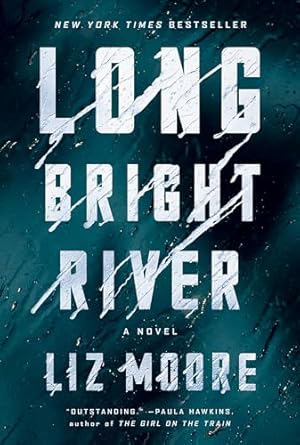
This book is tagged as a mystery/thriller, but I think it reads like literary fiction about a broken family. The main character is a police officer, estranged from her sister who is an opioid addict. The two girls were raised by a grandmother who was neglectful, hard, and closed off, due to the trauma of losing her daughter (the girls’ mother) to a drug overdose. Aside from the plot and the content about addiction and the way it can destroy entire families, there is a lot of commentary on social class, as well as various ways women and girls can be vulnerable to sexual exploitation.
I always look for the title of a book in the text – this time it appears twice in different contexts, both unexpected and evoking, for me, a visceral response. The first refers to a bulging vein, right before a drug is injected, the second is the people who have died of addiction: “People with promise, people dependent and depended upon, people loving and beloved, one after another, in a line, in a river, no fount and no outlet, a long bright river of departed souls.”
I’m not going to say much about the story, other than that I found it difficult to connect with the police officer who kicked her sister out of her home, then was on constant alert that she would respond to a call and find her sister dead. I wanted better for both of them, and for the grandmother too, and I felt very helpless and frustrated, wishing they had better solutions and better communication. For the most part, I found the characters to be believable, and, while I don’t agree with them, I found most of their actions to be plausible, though in many cases devastating. That said, given everything we eventually know about this character and her family, I really struggled with the choice of baby sitter for the officer’s child, especially since she had another option.
Aside from the plot of this novel, here are a few details that resonated with me or that I connected with in my life (I love doing this with books – it’s one of my favorite things about reading and is basically the point of this website):
The Nutcracker Ballet – anyone who knows me well knows that I love the Nutcracker. I spent a few fun years as Wardrobe Mistress for a local civic ballet (RIP) who put on this production every year with students from local dance studios, but before that, I took my daughter to see the show every December, and before that, I had happily watched it (mostly on PBS) many Christmas seasons. Anyway, there’s a scene in the novel featuring the lead character (future cop) as a young child, accompanying students from her class to the Nutcracker, for free, on a school day. She is mesmerized by the magic on stage, but is also dismayed that her classmates don’t know how to sit still – she learns some painful lessons about class prejudice and how she and her sister are perceived by strangers.
Higher education – the main character is referred to as gifted by her school, a distinction the grandmother immediately and frequently mocks and diminishes; when she later wants to attend college, the grandmother refuses to complete the financial aid forms and insists that college is some sort of trick and not for people like their family. A few days after reading this, one of my students mentioned, in a discussion about culture and social class, that many working class people perceive college to be elitist and not of value in the way “real” labor is valuable, which sparked agreement from many (most) of the other students. As an educator, this is something I think about (and worry about) a lot, that there is an increasing amount of anti-college sentiment. Many people have incorrect preconceived notions about my discipline in particular (that sociologists indoctrinate students to some sort of ideology, etc.), and I think we have inadvertently contributed to this by being inaccessible and yes, elitist – I try every day to counter this. I should also mention, I think all forms of education are important, from library books to trade schools to universities.
Sleep-training – When her little boy tries to sleep in her room, the police officer always returns him to his bed, and she sometimes wakes up to find him curled up with no covers at the foot of her bed. She had a neglectful, insecure upbringing, and I can see her reading parenting books and doing what she can to raise her child better. Here’s a quote:
“Then I think of everything I’ve ever read about how one instills strength and self-sufficiency in a child, how teaching a child confidence and independence young is essential to ensure the child will ultimately be a well-adjusted citizen and adult.”
I kind of thought of this as a symbol of many things the woman has lost. This was so sad to me – she is not a well-adjusted citizen and adult, and she’s trying to do better for her child (but I think she would do so much better just letting the child sleep in her room when he’s afraid).
Side note: This book uses dashes instead of quotation marks for dialogue, which, to me, gives a feeling of stream of consciousness (did she really say that, or did she only think it?). I haven’t listened to the audio version, but if unusual punctuation bugs you, the audio might be a better option.