I had a Greek mythology phase* as a child (alas, Rick Riordon’s books were a couple of decades away) – one summer I read every Greek mythology library book in the small town where I visited my Reina, and I also devoured my mom’s copy of Edith Hamilton’s Mythology – she had written her name across the pages in her beautiful cursive, and I felt so grown up when she allowed me to read her high school book. I memorized the names of the characters (and how to pronounce them), struggled to find their consellations in the stars, and toyed with the idea of someday learning Greek.
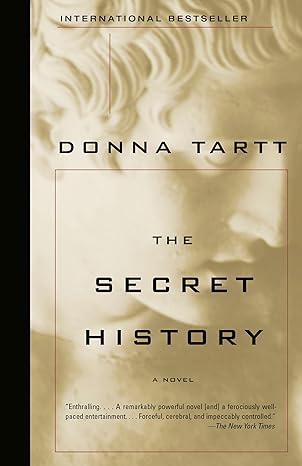
Not only did Donna Tartt’s immersive, evocative writing in The Secret History call back to my mythology summer*, it transported me to my literary teens, writing poetry and reading classics, some of my friends and I unironically proclaiming ourselves to be “promethean.” English teachers loved me, and I loved them, and when I applied to college seeking a biology major, my guidance counselor wrote in his recommendation that he saw me as eventually choosing a degree in English/Literature (he was a little bit right – Calculus 3 and Physics 1 did me in, but I eventually found my path in SOCIAL science). Being “literary” felt so serious and important then, but now, years later, I look back and see the naive enthusiasm, maybe sometimes bordering on pretentiousness, of that time in my life.
The Secret History is (unreliably) narrated by a young man recounting his days at a posh New England liberal arts college where, somehow, a wealthy eccentric has talked his way into teaching Greek/classics – for free – a small, handpicked group of students, giving himself complete authority over which classes they take. It is unclear how many of his proteges have graduated and gone on to careers, but this doesn’t seem to matter because he mainly selects students who are independently wealthy and unconcerned with money or credentials. The narrator is the lone exception, cleverly manipulating his way in thanks for a chance opportunity to wow the professor with his advanced knowledge of the Greek language. As his story unfolds and becomes increasingly dark, I became increasingly frustrated with him and his peers – older than my innocently promethean high school friends and I were, his group took college “Greek life” to an entirely unhinged level, indulgently cosplaying as actual Bacchanalians (way beyond drinking, drugs, etc.) ultimately becoming characters in a real life Greek tragedy of their own design.
Are they so obsessed with the “Literariness” (sorry) of their studies that they blur the lines between fiction and reality until they can no longer determine which is which? Most of them come from very privileged homes – have they been so indulged that they are able to play pretend with no thought to morality or to potential repercussions? This carries over into various aspects of their lives where they don’t seem to realize or be in any way bothered with the consequences of their own actions – for example, the main character, nearly freezes to death after renting an upstairs room with no heat and with holes in the roof during a harsh New England winter. None of them seem concerned for self preservation until suddenly, and tragically, they become very concerned.
And what of their professor, who hand selected these mostly upper class young people to sit at his feet (probably) as they discuss the words of the Great Greek Thinkers (in the ancient dialect, of course)? This reminds me that some stories will read much differently depending on the stage of life a person is in. Had I read this closer to my Promethean Days, I’m certain I still wouldn’t connect with the characters, but maybe I wouldn’t have been bothered by the virtual non-existence of the eccentric teacher who figures so prominently in the synopsis of the book. This might be a side effect of having an unreliable narrator, but as the book went on, I felt a bit like a victim of false advertising.
Closing thoughts – Donna Tartt is an excellent writer, in this case also a human time machine. I didn’t like the characters, but I will remember them for a long time (especially Bunny, who I initially despised, but I guess we were supposed to feel that way….). I know this book is often referred to as possibly the original “dark academia” book – I have read now read several in this genre and I really think this novel stands separately and above those that came later (especially those who might as well just refer to themselves as mediocre Donna Tartt fanfic – I’m looking at you, The Maidens by Alex Michaelides).
Side note: There’s a scene in the novel where the narrator mentions how, upon his new classmates learning that he grew up in Southern California, were immediately excited and then dismayed when he told them he had never visited the Labrea Tarpits. I had to laugh because I, too, grew up in Southern California, yet I had never heard of the Labrea Tarpits until after I became a parent (at least I don’t remember them being mentioned when I was a child).
*It wasn’t just that summer, and it wasn’t just Greek. I went on to read Joseph Campbell, and have since read many myths from all over the world. I even took a Mythology class in college (the closest I have ever gotten to pursuing that English degree) – it remains the most challenging and fun writing class I have ever taken.