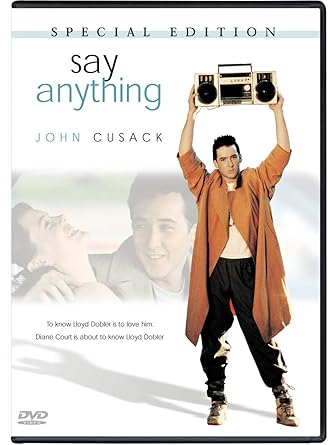
I feel a tiny stab of guilt every time I Google a word definition, and it’s all because of the iconic film, Say Anything. There’s a scene where Diane Court (Ione Skye), future valedictorian, shows Lloyd Dobler (John Cusack) her dictionary, shyly mentioning that she “used to mark all the words [she] looked up.” After watching the film, I immediately started to do the same, a habit that continued through two paperback editions of the Oxford English Dictionary (my favorite), right up until the time it got easy to look up words with my phone (I still keep a red pen near my current copy, just in case I decide to look up a word the old fashioned way).
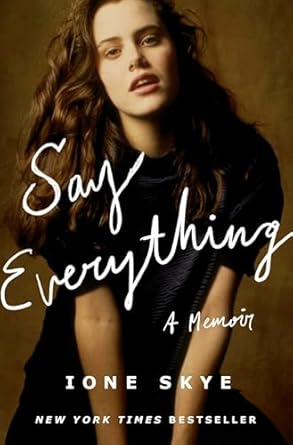
When I saw that Ione Skye had published a memoir entitled Say Everything, of course I had to read it. My libraries did not have the audio version – I’m sad I didn’t get to hear her narration, but the trade-off is that I got to see the many photos she included in the print and e-versions.
The title of this book is spot on – she is very matter-of-fact in her descriptions of growing up with a casually neglectful mother and unacknowledged by her absent, famous father, and I would have preferred far less intimate detail about her sex life (starting in her teen years). I kept wondering how the people named in her memoir feel about their “edits.”
The most striking thing about her story is that it provides an unflinching critique about being young in Hollywood in the 1980s. We tend to idealize the “good old days” (and they were pretty great!), but some things from the past should stay there. We were decades away from “Me Too,” and many things were taken for granted then that should not be considered appropriate today. I also know that drug abuse and the sexual exploitation of young girls aren’t only celebrity problems, but this is very much a celebrity memoir. Ione Skye started dating Anthony Keadis when she was 16 and he was 24, and this didn’t seem to set of alarm bells at the time, and, as she tells it, neither was it particularly frowned upon when she moved in with him at 17; some said this underage girl was “good for him” when she would ask people to drive her around the streets of Los Angeles after he had disappeared for days at a time on lengthy drug benders. She mentions loving Woody Allen but failing to impress him when they met, and that her favorite film from childhood was his Manhattan, about an older man who is dating and cheats on a high school girl. When she writes about seeing a younger Drew Barrymore at parties “during her little girl lost phase” and that “we protected her,” I could only think that none of these young girls were being protected (not just girls – she discusses the tragic loss of River Phoenix, and much more recently, Matthew Perry).
When she booked her first film, she explains that the studio required her to become legally emancipated from her mother so that she could drop of out school and work more hours. (Her mom responded to this by only asking her to please not move out!) She implies that all the studios did this, and I wonder if that was true then, and if it’s true today.
She has had a lot of therapy, and, while she explains some of her choices (constantly plotting new sexual conquests even when supposedly being in committed relationships) as being influenced by a feeling of abandonment by her father, she doesn’t tell her story as though she feels like a victim (even though sometimes she was one). At one point toward the end of the book, she quotes her teenaged daughter as saying, “I hope you’re not playing down how messed up it was with Anthony…it wasn’t okay, then or now. I think you need to be clear about that.” She also seems particularly contrite for cheating on her first husband, Beastie Boy Adam Horovitz.
I thought this memoir would be more nostalgic for me, but my childhood was so different from hers that it was hard to connect with her experiences. I did think about some of the posters I had on my bedroom closet door (Dweezil Zappa, River Pheonix, etc.), and it’s always great to hear nice things about Keanu Reeves. She also refers to herself as a “lifelong bookworm” and I added a few of the books she mentions to my TBR.
Side note: After reading this book, I keep randomly calling my husband and daughter “Buddy” (something I already did occasionally, but find myself doing a lot lately) – evidently, Adam Horovitz’ family had the habit of calling each other “Buddy,” and, as Ione Skye tells it, he started calling her this on their wedding day. I kind of love it.