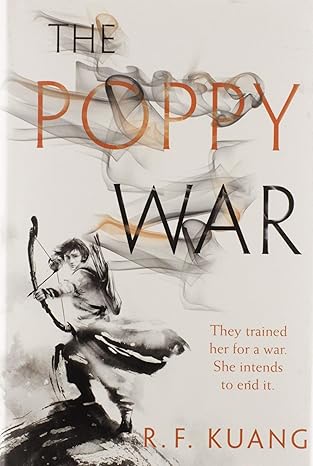
The Poppy War (Book 1 of a trilogy) was nominated for the Goodreads Choice Award in the Fantasy category, but I think it’s more accurately (alternate) historical fiction. I understand that the magical elements are why it falls under “fantasy,” but the a lot of the story (including the names of some people and places) are clearly based on (mostly Chinese) history. This might seem like semantics, but I will explain below why the distinction matters to me in this case.
The main protagonist of the book is a highly intelligent war orphan who uses her wits and intelligence to earn the chance to test into a highly selective and prestigious military academy. I initially thought the novel would be entertaining but somewhat formulaic, including various common elements (outsider orphan with extraordinary talents, magical? boarding school with various different houses/factions, Draco Malfoy, even the dreaded love triangle and/or enemies to lovers). These elements are all there, but there’s also some dark history motivating the teachers and students – two previous Poppy Wars, including a genocide, and the threat of a third, this time probably involving weapons beyond human imagination. If the author was inspired by Harry Potter, her story is much more serious and heavily influenced by actual historical events. There’s also a lot of commentary (at times a bit heavy handed) about colonialism, racism, colorism, class privilege, and the dehumanization of marginalized groups.
(Mild spoilers ahead):
Poppy/opiates, are a central element of this story, no surprise, considering the series title, and they are intricately connected with religious and philosophical beliefs. Opiates are used by some individuals as a means of escape, but in a broader scope, they function as a means of controlling people, but also to achieve enlightenment and to enable certain skilled individuals to enter the realm of the gods and directly call on them to intervene in human affairs. The protagonist, grew up working in her foster parents’ pharmacy, and has some inside knowledge into the poppy industry (both legal and criminal), and has seen firsthand the various consequences of opiate addiction. She is also initially skeptical about the existence of gods, and the mythology of this series unfolds in bits and pieces as part of her story. Others have conflicting beliefs about the power, control, and motivation of the gods, but the predominant view is one of contempt, where the gods are mistrusted and, at the very least, feared.
Partway through, the book takes a very dramatic shift in tone, ramping up the elements relating to war. There are several graphic scenes depicting horrific violence, including torture and attempted genocide. There’s even a lengthy, chilling, discussion of eugenics, complete with a creepy doctor who cheerfully voices his justification for his murder lab. This is the part where the distinction between fantasy and alternate history diverge for me – I know that some of these scenes closely mirror actual events, and I felt some ambivalence reading about them in this context. On the one hand, if teaching the worst of human history, even in a fantasy setting can help prevent such atrocities from ever happening again, obviously I support that effort. On the other hand, some of the details, to me, felt gratuitous, almost bordering on desecration.
On a personal note, one thing that truly terrifies me is the concept of not having free will. I try to avoid novels involving mind control, and I often remind my students that, even though we are influenced by social forces, we are ultimately responsible for our own decisions. A few scenes in this book left me wondering which position the author is taking on this topic – one character is seemingly programmed/fated in a certain way, then another scene contradicts this idea, then it swings back again. Also, there is a disturbing scene early in the novel when the protagonist gets her period for the first time (she has no idea what is happening to her) and requests a permanent remedy so she can be a better soldier, a decision she is praised for by the male doctor who immediately has her ingest a potion that “dissolves her womb” – is it free will if she lacks information that others could easily have shared with her? Will this factor into the story later on (I assume so)?
I was wondering if I was reading too far into things, or maybe it’s as simple as – whether or not you choose to take the opiates dooms you to a particular fate. Then the main character makes some surprising decisions, making me further question the idea of fate vs. free will, and then book ends and now I’m not sure what to think other than this – continuing with the series seems daunting, because I now don’t really have anyone to root for. I will probably read on, if only to see if the author turns things around.
What is my takeaway from the novel? Aside from my obvious support of anti-genocide messaging, etc., one scene I have continued to think about happens in the first part of the book. The orphan girl, determined to pass the placement exam that others have spent their entire childhoods studying for, memorizes entire books in a relatively short period of time. Her commitment to rote memorization reminded me of my students using flashcards when I used to give exams in my classes. Now I rely on project based assessments, in part because I think the ability to analyze is more important than simple regurgitation of facts. This got me to wondering about standardized testing and where we are locally and globally with regard to teaching critical thinking over rote memorization. I will have to look for current research on this topic.