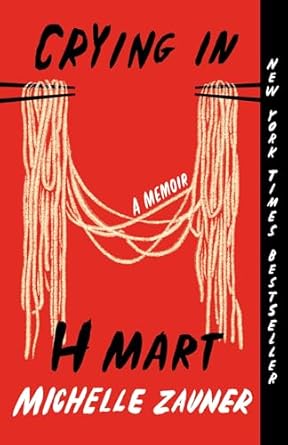
Michelle Zauner lost her mother to cancer (the blurb says it was pancreatic, but in the book she clarifies that this ended up being an incorrect diagnosis), and this memoir came out of her experience, not only of seeing her mother through to the other side, but her conflicted feelings about her culture (she’s mixed race) – for example, at one point she questions whether she can still call herself Korean if she can no longer call her mother for cooking advice.
“Crying in H Mart” refers to her literally weeping in the Asian grocery store when she thinks about calling her mother to ask about ingredients or when she remembers something her mom used to cook. Sometimes the writing seems self indulgent and self absorbed, she’s wallowing in grief, silently crying in public spaces, making the loss about herself. That said, I found myself connecting with some of her sadness – grief is very personal and isolating, partly because it makes other people uncomfortable. She’s angry at old women eating soup with their adult daughters and their grandchildren when her mother will never be an old woman or know her grandchildren – she was in her 20s when her mother passed, and she’s right, it’s terrible that they didn’t get more time together.
She and her mother spent many years struggling with their relationship, and this is a common thread throughout the book. I normally struggle with stories about people with “complicated” relationships with their mothers in part because of cultural differences; Zauner’s earlier chapters contain some of this, but I think she later makes an effort to understand her mom’s perspective and that of other women in her extended family.
I’m sure it was cathartic and hopefully healing for her to write this, but at times I, as a reader, felt very uncomfortable with some of the recounting – some moments seem too personal, like we should turn our heads away to give her mother some privacy, like maybe Zauner shouldn’t have pulled the curtain back quite so far. I also wonder how her dad feels about what she has written about their relationship (I always wonder this about memoirs though).
I keep thinking about one line in the book:
“Some of the earliest memories I can recall are of my mother instructing me to always “save ten percent of yourself.” What she meant was that, no matter how much you thought you loved someone, or thought they loved you, you never gave all of yourself. Save 10 percent, always, so there was something to fall back on. ‘Even from Daddy, I save,’ she would add.”
Zauner later refers back to this advice and expresses dismay upon learning that her mom kept things from her, as well. I had to rewind the audio to listen to this line again, and maybe this gives me some insight into how some people seem to have an easier time grieving than others. I miss my people who have gone before me – it feels, to me, like they took a part of me with them that I won’t get back until we are reunited. Maybe, if I had had held something back, I would not feel this way, but I’m glad I didn’t compromise because I have so many great memories of the people I love who have moved on. It’s also possible that I would feel differently if I didn’t strongly believe and expect to be with them again someday.
On a positive note, one moment in the book that resonated with me happens during her wedding. She talks about her wedding vows and how, watching her parents go through the “in sickness” part of their marriage vows helped her to realize the importance of marriage, something she hadn’t previously considered. I often have students tell me they aren’t interested in ever getting married because “it’s just a piece of paper” and I think Zauner does an excellent job of explaining that it’s much more than that.
Also, I really enjoyed reading about her efforts to connect with her mother’s memory by learning to cook some of her the things her mom used to make (mostly through watching YouTube videos). I think about my Reina’s (maternal grandma and the love of my life) cooking a lot – for example, I rarely eat apple pie because none will ever compare with hers. My favorite thing my paternal grandma used to cook is a delicious broccoli chicken casserole that we lovingly refer to as “recipe” (let’s have “recipe” for dinner tonight). Reading this book has inspired me to honor my ladies by learning to cook more of their foods too. I have long wanted to learn how to make tortillas from scratch (growing up, my Reina used to do this daily, but she didn’t have a written down recipe, she just knew how) – I think that’s where I will start.