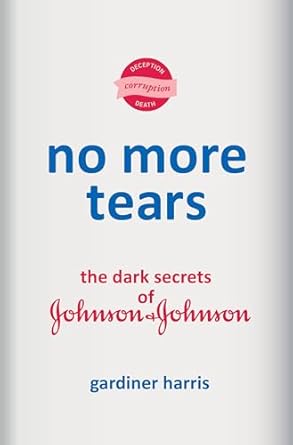
No More Tears is a well-researched expose of Johnson & Johnson, a company so ubiquitous that most of us are probably familiar with their tagline – “a family company” – and we probably have no idea how many of their products we have in our homes because they own many companies. The bottom line – Johnson and Johnson has likely caused countless deaths on top of numerous injuries, yet as long as they were making money, they engaged in such actions as hiding their own scientific studies, faking research, and negotiating with government agencies and others to bring unsafe, harmful products to market time and time again. So many decesdions could easily have been made in favor of public health and safety, but instead, the company acted in favor of maintaining and growing massive profits. They seem to have considered the fines they have paid out to be just part of the cost of doing business.
The book begins with a detailed history of their well-known baby powder. Thought the company knew, literally for decades, that the majority of their supply contained cancer-causing asbestos(the bottles containing talc are unlikely NOT to contain at least traces of it), they continued selling the asbestos laced version at least in parts of the world until 2023! Their own research and that of independent scientists showed that even a miniscule amount can cause ovarian cancer (and some women have used baby powder from infancy well into adulthood). J&J willingly falsified their data and, though it would have been relatively easy to switch to safe cornstarch, they fought this change for years with the rationale that, to make any changes could cause the public to doubt the integrity of the entire company.
After reading Empire of Pain, about the Sackler family and how they are largely responsible for the opioid epidemic, I did not expect to find another company (family or otherwise) more villainous. Oh well – it’s Johnson & Johnson. Case in point – they purchased opium poppy fields in Tasmania, where they developed an extra potent strain (the Norman poppy), then became the major supplier of this raw material that enabled the Sacklers and others to make the drugs that continue to kill so many people (yet continue to be prescribed to this day).
The book covers numerous other medications and medical devices, but probably the one that struck me the most was Tylenol. A few months ago my faith in the safety of Tylenol was shaken when I broke out in severe hives after taking a multi-symptom cold medicine containing acetaminophen; I have take this particular product numerous times, but this time I had trouble shaking the illness, and probably took if for a longer period than the usual day or two. After struggling to figure out why I suffered such a major reaction, I read the warning on the bottle of medicine and learned that this is a known issue with this medication. This was shocking to me, since I have always heard of Tylenol as being the safest OTC pain medicine, the one most often recommended by doctors. Recently, a family member who was suffering from, among other things, elevated liver enzymes, was given Tylenol in the hospital, though the one warning that I knew about prior to this incident is that it can be tough on the liver.
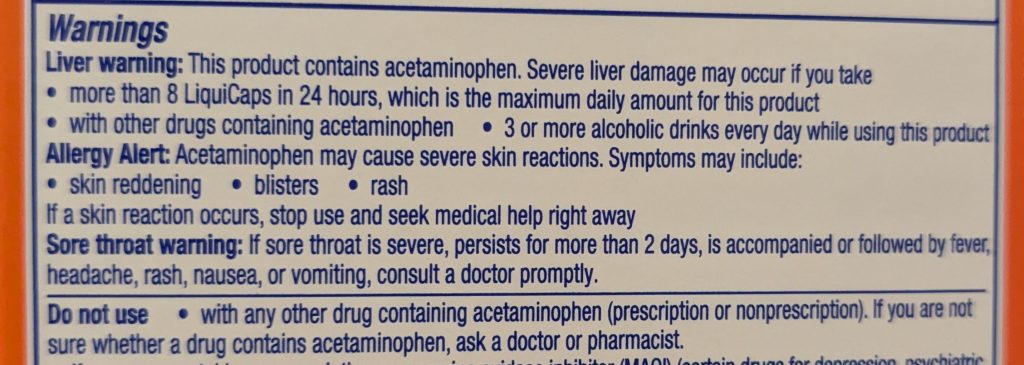
When I got to the lengthy section on Tylenol in this book, I was surprised to learn that it’s actually the most dangerous of the over the counter pain medications. According to the author, because other OTC pain meds can cause intestinal and stomach distress and even bleeding, their dosages are set well below the actual maximum safe limit. This is not the case with Tylenol. Evidently, the company was able to sell the idea that, since it does not cause harm to the stomach (and because antacids and other medications now exist to help mitigate stomach symptoms), J&J was able to successfully lobby to have a higher maximum recommended dosage. Then, in order to add a maximum strength option, they received permission to set the maximum recommended dosage to hit the maxim safe limit, meaning that taking an extra pill by accident can spell disaster. After reading this, we searched the pain medicine aisle in a few stores and were unable to find anything but “extra strength” acetaminophen for sale, regardless of brand.
This book was appalling and educational for me, in particular the sections of government oversight, and how the FDA has long been complicit in the harm J&J has done to consumers and will likely continue to be. I could go on and on about what I learned, but instead I will just say that it is worth reading. I will have to purchase my own copy (I read an ebook from the public library) so I can read it again, take notes in the margins, and do a deep dive of the detailed references included. On that note, in the previous version of this website, I used to write multiple posts about non-fiction books, adding observations and analysis over several reading sessions instead of writing a traditional review. When I read this for the second time, I might post again as I read it more slowly.
(Not so) funny story – when I wrote my Goodreads review of Empire of Pain, I mentioned being offered opioids in the hospital after the birth of my daughter (though it was charted that I am allergic), for “for pain that could be (and was) treated with nothing stronger than a couple of Tylenol tablets.” I’m still glad I didn’t take the opioid, but I probably should have just asked for some good old aspirin.