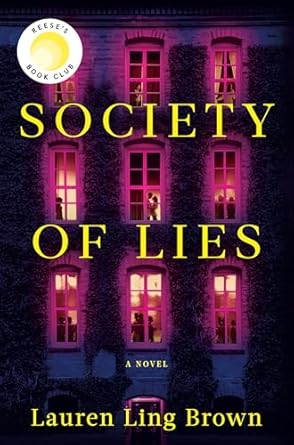
The first time I started reading Society of Lies, I was deep in the process of watching my daughter apply to college, trying to uncover the secret formula to acceptance in a high tier school. Don’t trauma dump on the personal essay! Well roundedness is no longer a virtue – now you have to show major depth in one area! Everyone has great grades and test scores, tell us about your passion project and years of leadership! When the main character in this novel said (to paraphrase) “I read a lot of books and got myself into Princeton,” I let my library loan lapse – she made the nearly impossible seem too easy. Now that my child is happily and successfully attending a highly rated (public) University, I could finally read this book.
Author, Lauren Ling Brown, said, in her Goodreads review for her novel, “I wrote this story during the pandemic, during a low point in my life and a divided time in America, hoping it would reach other people like me who felt like outsiders at this time in their lives. It was inspired by the moral question: if you were invited to join a society that promised you the life of your dreams but then you learned that they were hurting someone else, would you stay?” She also, of course, says that Princeton is a great school and that the events depicted in this novel are purely fictitious.
Social class is the main dividing line in this novel, and the secret society in question is comprised of people who quietly control every social institution, building their wealth and resources with no regard to laws or morality. The main characters are female, mixed race, and orphaned, adding additional layers of separation between them and the wealthy white men who run the secret society and, by extension, everything else. I was very interested and invested in the story of these two outsiders not only attending an Ivy League university, but obtaining access to a highly exclusive and secret organization while there. The author does a great job of depicting this “otherness,” so to that end, I’d say she accomplished one of her goals.
As for the moral question, it is plausible that an outsider would be tempted to justify bad behavior in order to achieve a place at the top (or at the very least, a comfortable life for their younger sibling) – it makes sense that this level of power can have a corrupting influence. I do wish there had been more nuance with regard to the various characters – some of the society members are so casually cruel seemingly for no other reason than that they can be. It’s not much of a surprise that the bads/wealthy can easily justify disposing of anyone who presents an obstacle.
I was also disappointed in the relationship between the sisters, so much that I had trouble feeling sympathy for them. They kept so many secrets from each other (especially the older girl whose supposed main goal was to protect her younger sister and give her the best life possible), and this led to disaster. It always annoys me, in fiction, when simple communication would have prevented the entire tragedy from occurring; maybe it’s because I have read so many books using this plot point that I think people should do better! I think about this a lot. Sometimes, in my real life, I think – if I don’t say something to my (husband, sister, mom, etc.) right now, am I the character in the novel who destroys their life or someone else’s by keeping silent, or by not asking my person for clarification? Maybe fewer books would be published if authors thought this too, or maybe the ones published would be better.