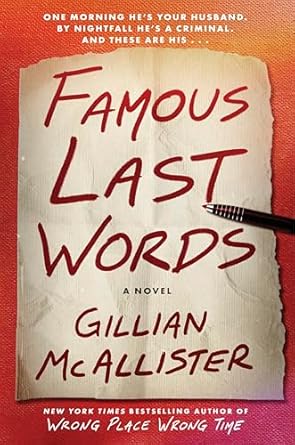
Famous Last Words is a thriller centered around a married couple. She is a book editor, he a ghostwriter, and they are new parents. On the day she is scheduled to return to the office after maternity leave, he disappears before she wakes up, leaving a cryptic note. She soon learns that he has taken three unidentified people hostage in a warehouse.
This is a story about marriage, how well one can know their spouse, whether or how much we take one another for granted, and the nuances of communication between those we are closest to. The narration alternates between the woman and the hostage negotiator, which gives us insight into two different relationships. There are a few unexpected twists, only a couple of overly convenient plot points, and, though I guessed the solution to the mystery early on, I still enjoyed reading the book.
Writer, Gillian McAllister, gives one of her characters the thought that “[m]aybe fiction is one of life’s great comforts.” Also, the husband, speaking of his wife, thinks, “To real readers, sales don’t matter, prizes don’t matter. She sits in a chair every night and just has the time of her life.” This really resonated with me, an avid reader who at times (not recently) puts fiction on a back burner. I have read a lot of nonfiction – I especially love biographies and memoirs, but I also enjoy history, current events, science, religion, and of course, social science. For a long time, I kind of thought of fiction as less worthy of my limited reading time, so I would go many months without any fiction at all. Then my life got to be quite solemn, with illness in the family, some of my favorite people leaving to the next life, and I dove into fiction (eventually discovering a love of cozy mysteries). I have recently added back an increasing amount of nonfiction to my reading, leaving less time for cozies, and I have been thinking about how I would like to keep room in my life for a wider array of reading, even “potato chip” fiction.
Though not central to the story, one thing that really bugged me in this novel is the way the main character expresses guilt about her sister’s infertility, specifically, feeling like she needs to keep her own daughter away from her sister in order to spare her additional pain. She goes on at length about how horrible her sister must feel, having to, for example, pick up her niece from preschool, when she hasn’t been able to successfully bear a child of her own. Maybe these sentiments will resonate with some readers, but I found them to be oddly self absorbed and probably counter productive.
Side note 1: There are a lot of metaphors in the book, some that are so odd that they sometimes pulled me out of the story. A couple of random examples:
“it sits in the exact center of a load of buildings, like an empty stomach in the human body.”
“an unusual summer mist…coming off the river like ripped-up cotton candy after the wet night.”
Side note 2: There’s one scene in the book where the mother, at bedtime, has her daughter recount what she did throughout her entire day, going backwards (what did you do before that, then before that…) “so my daughter could get into the habit of processing her days instead of floating through them, outside herself, like I had as a girl.” I floated through many of my days of childhood (especially in summer), yet I don’t remember feeling as though I was outside myself. I’m curious to know what others think of this idea. Maybe the point is just to think about one’s experiences – as a child, I often ruminated about certain things – still do, and sometimes I kept a journal to help me process my thoughts – sometimes I still do.